
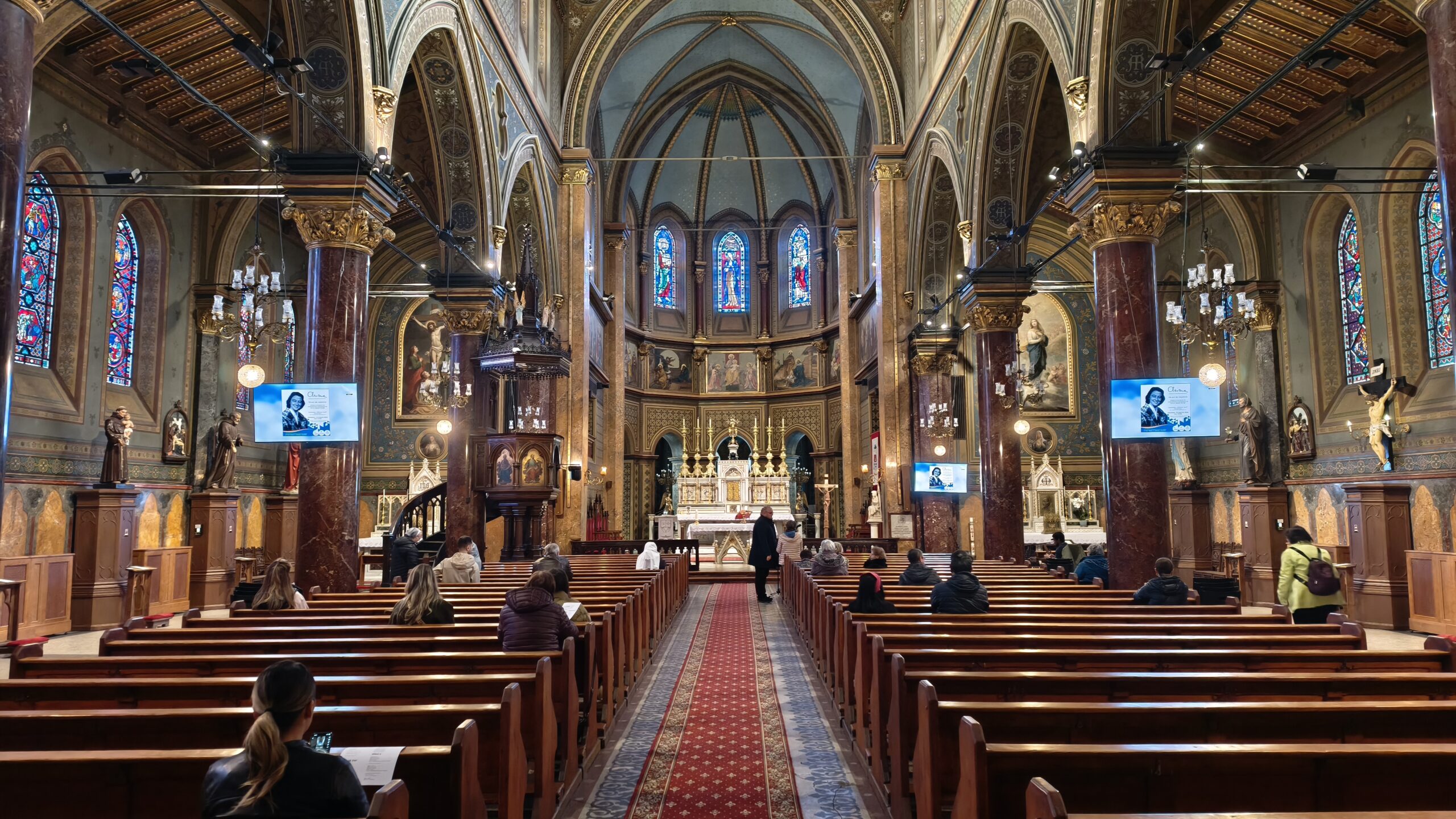
Discover the living soul of Catholic heritage in Bucharest at Saint Joseph Cathedral , where faith and history converge.
In a city that wears its contradictions proudly — communist blocks next to Belle Époque palaces, Orthodox domes beside modernist glass — Saint Joseph Cathedral stands as something quietly extraordinary: a fully European, thoroughly Catholic masterpiece rising from the very heart of Bucharest.
Known locally as Catedrala Sfântul Iosif, this is Romania’s most important Roman Catholic church, the seat of the Roman Catholic Archdiocese of Bucharest, and — once you step inside — one of the most beautiful interiors you will encounter anywhere in the country. Yet remarkably, many visitors walk right past it.
Don’t make that mistake.
Saint Joseph Cathedral: A European Cathedral Built on Romanian Soil
The story of Saint Joseph Cathedral is, appropriately for Bucharest, a story of collaboration across borders. Construction began in 1873 under the vision of Bishop Ignatius Paoli – an Italian Passionist monk who would become the first Archbishop of the Roman Catholic Archdiocese of Bucharest. He tapped a Dutch Passionist architect, Alfons Zegers, who had been brought from a monastery in Dublin. The designs came from Viennese architect Friedrich Schmidt — the same man who designed Vienna’s own City Hall. And from 1880, a Romanian architect of Silesian origin, Carol Benesch, led the works to completion.
The stone came from quarries in Ruse, Bulgaria. The bricks from Bucharest’s own villages. The money came from Catholic believers across the city, from wealthy Romanian personalities, and from foreign benefactors befriended by Bishop Paoli.
Progress was anything but smooth. The Romanian War of Independence in 1877 halted construction, funds dried up repeatedly, and the work stretched across a decade. But on the 15th of February 1884, Archbishop Paoli consecrated the completed cathedral in the presence of Romania’s entire diplomatic corps, the President of the Senate, the Mayor of Bucharest, and priests from across the archdiocese. It was, by all accounts, a remarkable day for the city.
The Architecture: Romanesque Heart, Gothic Soul
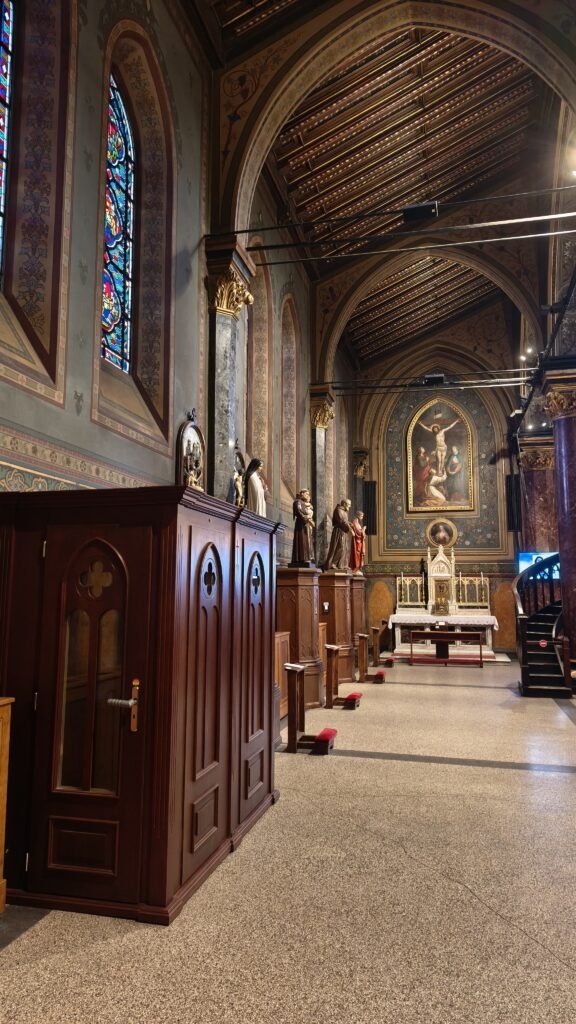
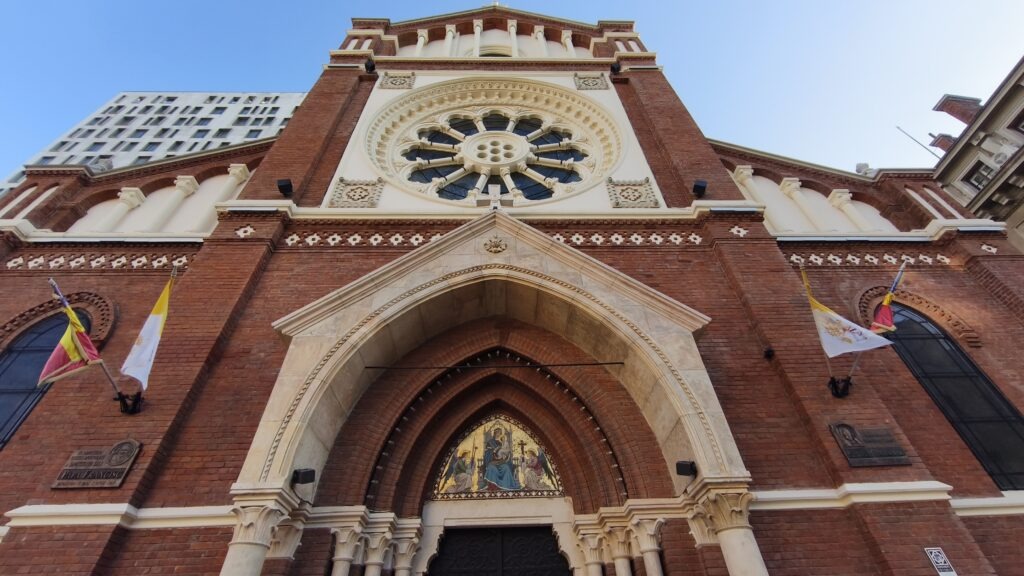
Standing before the cathedral on Strada General Berthelot, what strikes you first is its composure. This is not a building that shouts. It is 40 metres long, 22 metres wide, and its style belongs to historicism — a harmonious blend of Romanesque solidity and Gothic aspiration. Pointed arches, decorative buttresses, and a magnificent rose window all speak to a building that was designed to feel simultaneously ancient and timeless.
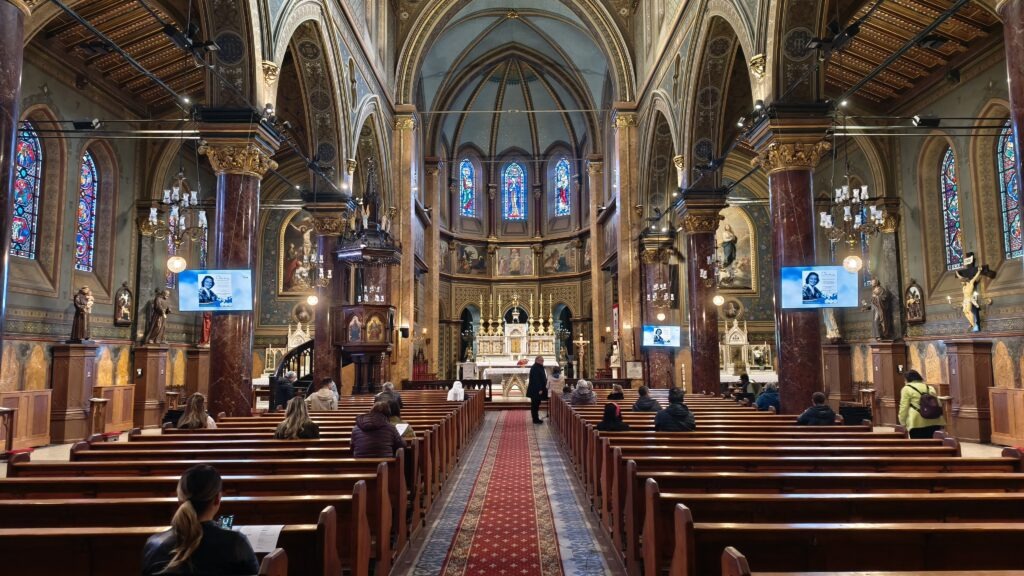
Step inside and the atmosphere changes entirely. The ogival vaulting soars overhead. The main altar — executed in Rome from white Carrara marble, to designs by Friedrich Schmidt himself — glows at the far end of the nave. The intricate woodwork of the ceiling was crafted in Braşov. The decorative painting of the nave was completed by Georg Roder of Munich. The stucco colonnades and pillars were shaped by the Italian workshop of the Aterio brothers.
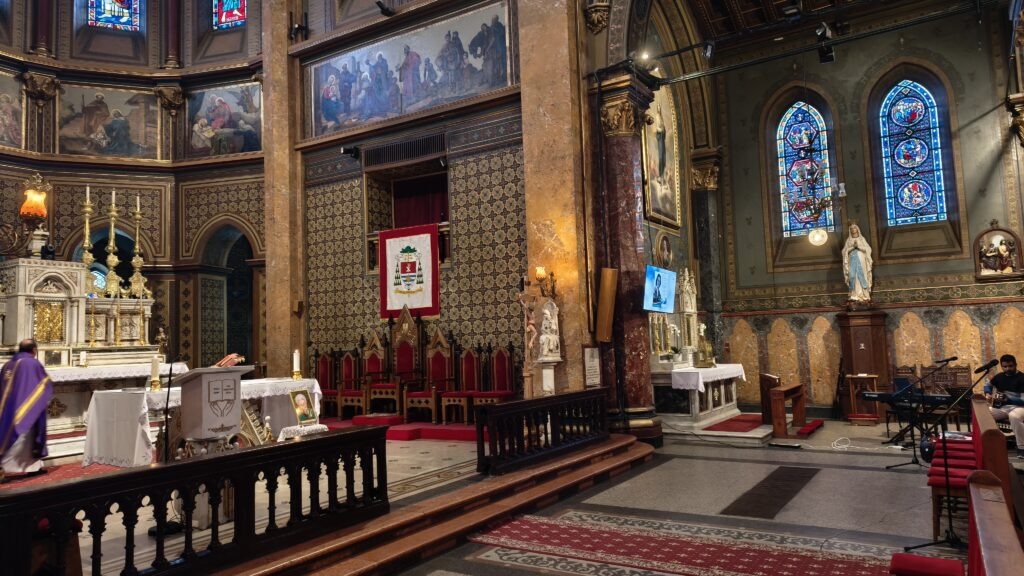
The original stained glass windows — produced by the Mayer company of Munich and depicting scenes from the life of Saint Joseph and the Holy Family — were destroyed in the Allied bombing of April 4th, 1944. The current windows, designed by Natalia and Ion Brodeală in 1980, fill the nave with warm, coloured light that still manages to feel entirely right. Above the organ, a large rose window by artist Dorin Dănilă (1985) is particularly striking.
The Organ: One of Bucharest’s Finest
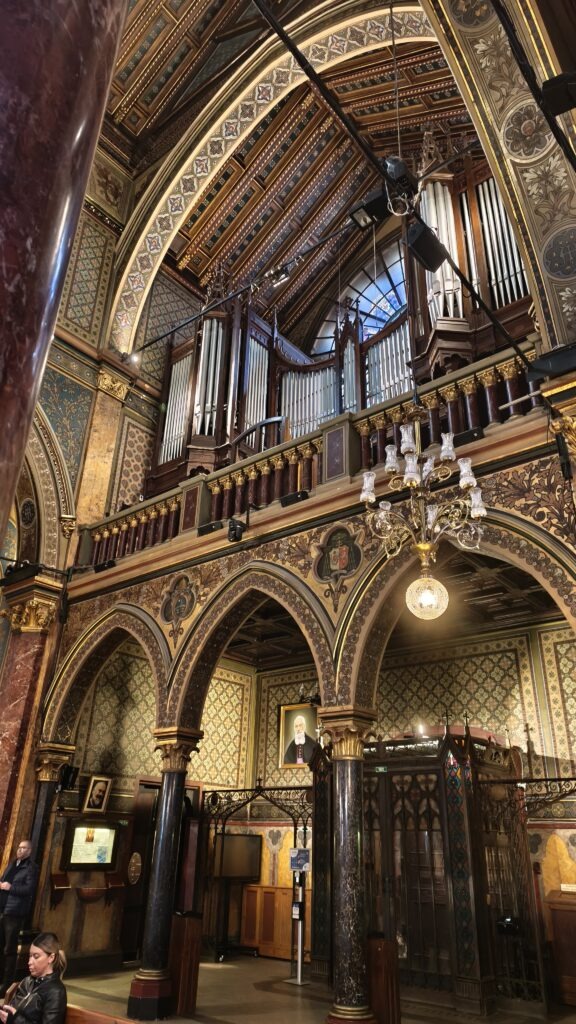
Few visitors expect to encounter one of the city’s great musical instruments here, but Saint Joseph Cathedral houses an extraordinary organ. The current instrument — built and installed in 1930 by the Leopold Wegenstein firm from Timişoara, replacing the original 1892 Parisian organ — boasts 3,375 pipes and a musical range that has made it the centrepiece of countless concerts and liturgical celebrations over the decades.
The cathedral holds up to 700 in pews, and nearly 2,000 at full capacity. When the organ fills that space, it is something that stays with you.
Survival: Earthquakes, Bombings and Resilience
Like so much of Bucharest, Saint Joseph Cathedral has endured extraordinary hardship. Major earthquakes struck the building in 1929, 1940, 1977, 1986, and 1990. The 1977 earthquake — one of the most devastating in Romanian history — caused severe damage to the interior and exterior alike. The cathedral also suffered from both the American bombing of April 1944 and the German bombing of August 1944.
Each time, the cathedral was repaired. It was not until 1991 that a truly comprehensive consolidation project began, designed by Professor Alexandru Cişmigiu, restoring the building systematically for the first time. The cathedral has since been declared a monument of art and architecture — a status it richly deserves.
One moment in its modern history stands above all others: on the 8th of May 1999, Pope John Paul II visited Bucharest and concelebrated the Eastern Rite Mass here together with the entire hierarchy of the Greek Catholic Church in Romania. It was a historic encounter between East and West that took place, fittingly, in this most European of Bucharest’s churches.
Practical Information
Address: 19 Strada General H.M. Berthelot, Sector 1, Bucharest
Entry: Free (donations welcome)
Weekday Mass: 7:00 · 8:00 · 9:00 · 17:00 · 18:30
Sunday Mass: 7:00 · 8:00 · 9:00 · 10:30 (High Solemn Mass) · 12:15 · 17:00 · 18:30
Feast Day: March 19th (Saint Joseph)
Photography: Not permitted inside during services
Getting there: 10 min walk from Piața Universității; trams 1, 10, 25
Why You Should Visit the Saint Joseph Cathedral in Bucharest
Bucharest is rightly celebrated for its Orthodox churches, its communist-era grandeur, and its Art Nouveau palaces. But Saint Joseph Cathedral offers something different: a glimpse of the city’s cosmopolitan Catholic heritage, built by and for a community that has always been part of this city’s fabric, even if not always its most visible thread.
It is a place where organ music reverberates through Carrara marble, where Bavarian glass painters and Braşov woodworkers and Roman sculptors left their mark on a building that belongs entirely to Bucharest. Whether you come for the architecture, the music, a moment of quiet, or simply out of curiosity, you will not leave disappointed.
Enjoy your visit!